
You Approved the Design, but Which Version?
The design was approved, but no one knows for sure which version. It happens more often than you think, and the cost is always the same: remaking the case.
TL;DR
When revisions to a prosthetic design travel via email or messaging apps, it is easy to lose track of which version was actually approved. With Dentra Core, approval happens directly on the correct 3D file, in a single place, before production begins.
The lab mills the restoration, the dentist receives the job and asks: "Wait, didn't we say to move the margin?". The lab replies that the design had been approved as is. The dentist swears they sent a revision. Maybe they did. Maybe it was in a message from three weeks ago, buried among ten others.
Neither of them is wrong. The problem is that the design was scattered across five different places, and neither was looking at the same version.
This happens when the approval workflow doesn't have a single home. The file goes out by email, a screenshot comes back as a reply, then there's a voice note saying "the last one I sent is fine", then another email with adjustments. At that point, the CAD designer has three different instructions and has to guess which one is the latest.
It's not a matter of care or professionalism. It's a tooling problem: when revisions travel through different channels, there is no way to know for sure which version was approved. And when you stop production to ask for confirmation, you lose time. When you don't ask and just push forward, you risk milling the wrong design.
The cost of remaking a prosthetic case isn't just financial. There is the time, the patient's discomfort, and the awkward conversation between the practice and the lab about who dropped the ball. And usually, nobody did: the system just didn't work.
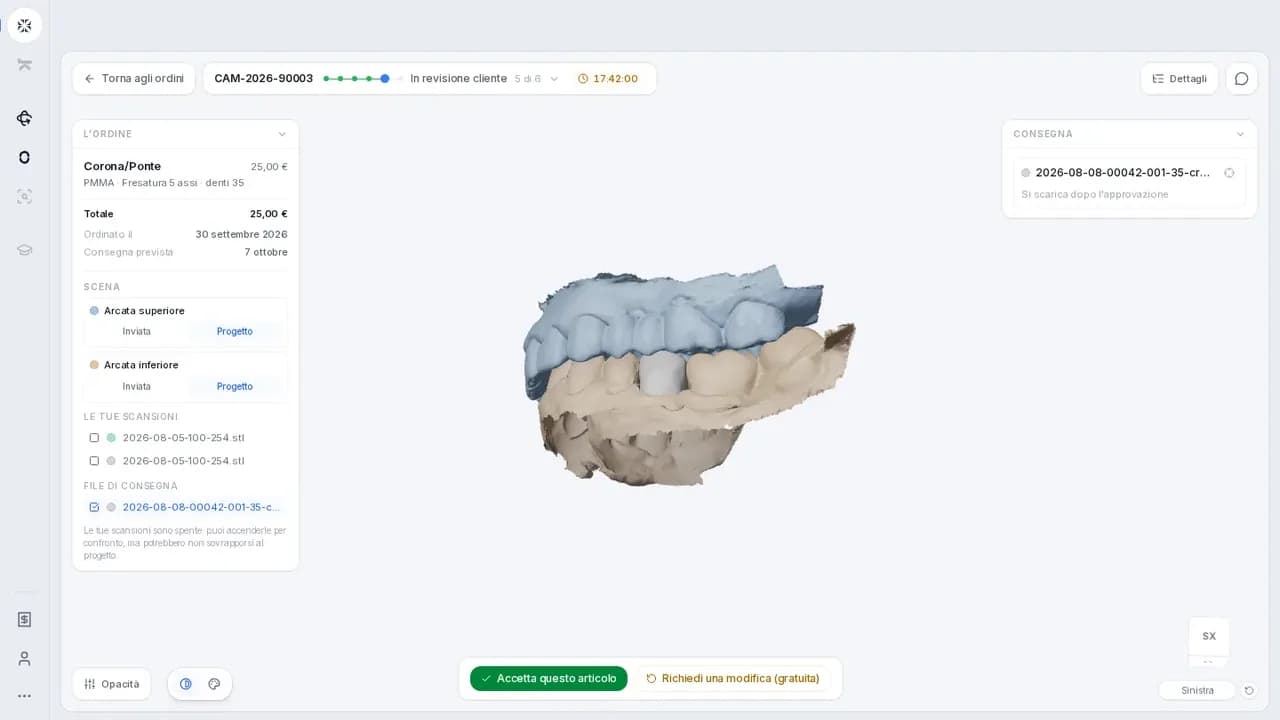
With Dentra Core, the entire review and approval cycle takes place in one single place, directly on the actual 3D design.
When the design is ready, whoever needs to approve it views it directly within the platform: not a screenshot, not a PDF, but the fully navigable 3D model. You can rotate it, zoom in, inspect the preparation margins, and check contacts with adjacent teeth. If something is off, the revision is requested right there, clearly linked to that specific file version.
When the approval comes through, it's the approval of that exact design. Not an image. Not an ambiguous message. The approved design is the one sent to production, and everything is tracked.
The real advantage isn't just preventing mistakes. It's that the turnaround time shrinks.
When you don't have to chase down confirmations via messaging apps, when you aren't waiting for someone to reply to an email sent on a Friday afternoon, the case moves forward. The CAD design arrives within 24 working hours of order confirmation, and from that point on, the approval step is already structured: no phone calls to check if it has been reviewed, no doubts about which file is the final one.
For a dental lab handling multiple orders in parallel, this changes your whole day. For a clinic ordering directly, it means not having to micromanage every single case step by step, because the platform does it for you.
There is another aspect that usually gets overlooked at first: accountability.
If a dispute arises over a case, the question is always "who approved what, and when". With a workflow scattered across emails, text messages, and screenshots, answering that question is tough. With Dentra Core, you have a complete audit trail: the design, the requested revisions, and the exact timestamp of approval. You don't need to rely on anyone's memory.
It's not about a lack of trust between colleagues. It's simply about working in a way where everything is clear to everyone, every time.
If you often find yourself in that spot where "the design was approved, but nobody knows which version", the problem isn't the communication with the lab. It's the tool you're using to manage that communication.
Try Dentra Core at dentra.it/it/dentra-core: order your design, track the status in real time, and approve the 3D model before production starts.
Founder and CEO — Dentra
Second-generation dental technician, specialised in dental CAD/CAM, 5-axis milling and Toronto Bridge design. Founder and CEO of Dentra.