
You Sent the Scan: Who Checks That the Design Is Right?
The scan is sent, the design will arrive. But will anyone actually review it before the restoration goes into production? Here is where the most expensive error in the digital workflow hides.
TL;DR
Sending the scan is not enough: the CAD design must be reviewed and approved before production. With Dentra Core, the dentist or dental lab views the design in 3D, requests adjustments, and gives the green light in a single tracked step before the file goes to milling.
You uploaded the scan, typed up the case notes, and hit send. From that moment on, in most workflows, you stop existing until the finished restoration lands on your bench.
The design is created. Maybe it gets emailed as an attached file or a screenshot. Maybe you get a link to something you’re not quite sure how to open. Maybe nothing arrives at all and the lab goes straight into production because "it was a standard case." And you, in doubt, reply to the message with an "ok" without having seen anything specific.
Then the restoration arrives at the practice. And that’s when you discover the margin is off by half a millimeter compared to what you expected, or that the Toronto Bridge contour doesn't follow the line you specified, or that a piece of information was missing that you would have provided right away if someone had just asked.
The problem isn't the CAD designer; the problem is that there was never a formal stage where you looked at the design and said: yes, go ahead.
Why the Approval Stage Gets Skipped
In the traditional workflow, design approval is inconvenient for everyone. For the lab, it means waiting, starting a back-and-forth conversation, risking revisions. For the dentist, it means finding the time to open a file, figuring out how to view it, and providing useful feedback. So everyone takes the shortest route: produce it first, fix it later if needed.
The cost of this shortcut is always the same: remaking the case, entirely or partially. Along with the resulting waste of time, rescheduling the patient, and wasted material.
It’s not a matter of the designer's skill. It’s a process issue: if the verification step doesn't exist, no one can perform it.
How Verification Works in Dentra Core
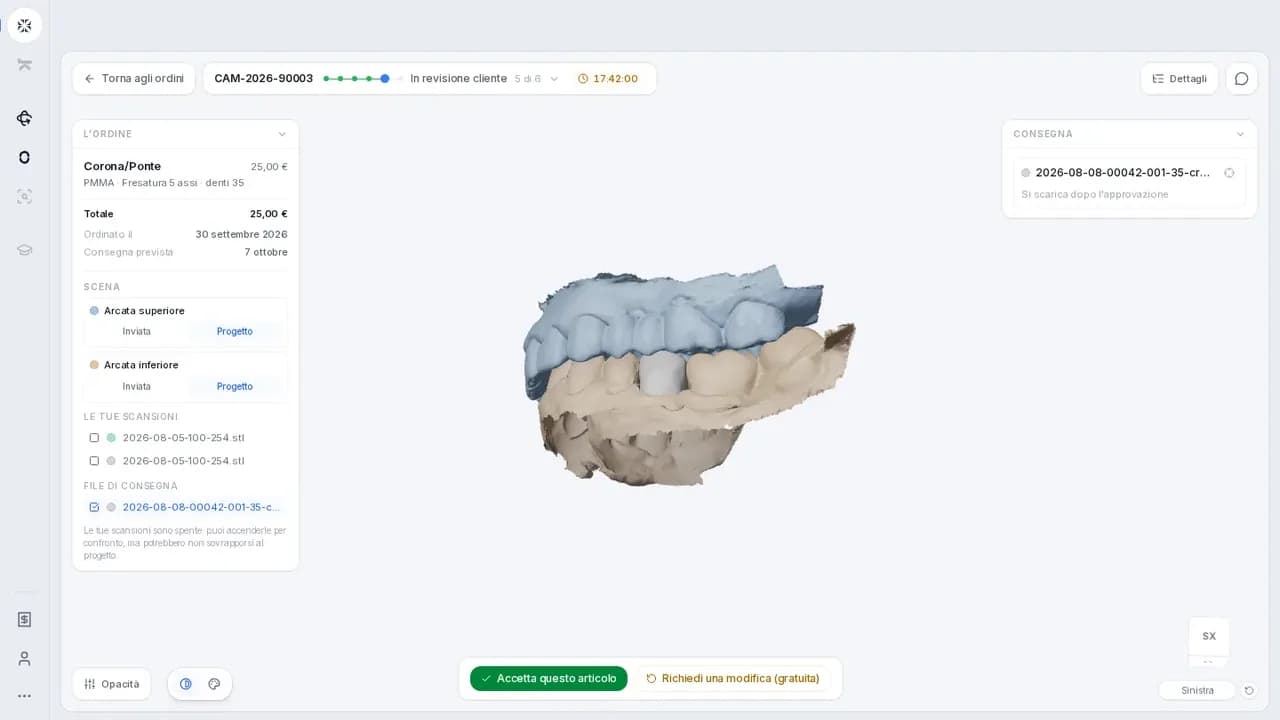
With Dentra Core, design approval is a built-in step, not an optional one. Once the designer finishes the CAD drawing, the file goes back to whoever placed the order: the dentist or the lab views it directly in 3D on the platform, without having to download software, without having to open files in proprietary formats.
You inspect it, rotate it, check the margins, the emergence profile, the shape. If something is off, you flag it right on the same screen. If it looks good, you give the green light. Only after that moment is the file ready to go into production.
All of this is logged: who approved it, when, and which version of the design. Not an email to dig up in your archives, not a WhatsApp message to track down in your chat history. A fully traced step within the very platform where you placed the order.
The design arrives within 24 working hours of confirmation. The approval stage is when you confirm that the design is ready to proceed.
What Changes in Practice
If you work in a practice with an intraoral scanner, you can order the CAD design directly through Dentra Core without going through a lab. You receive the file, approve it, and then decide what to do with it: send it to your trusted lab, have it manufactured in your preferred material, or trigger the production order to a partner lab directly from within the platform. Either way, you saw the design before anyone milled it.
If you are a lab dealing with a design overflow, the logic is identical. You order the design for the cases you can't handle in-house, receive the file, check it yourself or send it to your client for approval, and only then proceed. There is no such thing as "let's start in the meantime and fix it later": the workflow features a precise stop point.
This also transforms your relationship with the patient. If the design was formally approved prior to manufacturing, you can state with certainty what you validated and when. For a custom-made medical device, within a regulatory framework like the European one, this is no minor detail.
The Only Stage Where You Can Make Changes at Zero Cost
Before production, you can fix anything. Afterward, virtually nothing—or next to nothing without extra costs.
Anyone who has worked digitally for a while knows this. Yet the approval phase is still the one that gets squeezed or skipped entirely, because it’s cumbersome to manage outside a structured system. It requires coordination, waiting on a response, and keeping track of which file version was reviewed.
Dentra Core was built for this reason too: to ensure that this step actually happens, that it's easy to carry out, and that it leaves a clear trail. The case does not move forward until you have seen it.
If you haven’t tried it yet, you can create an account on Dentra Core and order your first design directly online.
Founder and CEO — Dentra
Second-generation dental technician, specialised in dental CAD/CAM, 5-axis milling and Toronto Bridge design. Founder and CEO of Dentra.