
You Changed Something in the Design: Does the Lab Know?
A last-minute correction, a WhatsApp message, a quick phone call. And the lab still ends up working from the wrong version. Here is why revisions get lost and how you can prevent it.
TL;DR
When a CAD design is modified after the initial submission, the correction often fails to reach the production team. With Dentra Core, all revisions live in a single place with a detailed history: whoever approves knows what they are approving, and whoever works knows what they received.
There is an error that repeats itself in almost every dental practice and dental lab working digitally, and usually, you do not recognize it until the damage is done: a design change made outside the main channel.
Here is how it goes. The CAD design is in progress, the patient mentioned they want something slightly different, or the dentist took a closer look at the scan and changed their mind about a margin. A message is sent, a call is made, an email is written. On the other end, they reply "ok, I'll update it." And that is where the problem starts.
Not because the person on the other end is careless or sloppy. The problem is structural: the change left the design and entered a conversation. Two things that do not talk to each other.
The Version That "Was Supposed to Be Updated"
Think about how it works in practice. The design file has a name, maybe with a date or a version number. Then the modification comes in: the file is re-saved, maybe with a slightly different name, maybe not. The technician handling production has already downloaded the previous version. Do they know there was a change? Maybe yes, if they read the message carefully. Maybe not, if they were busy when it arrived.
And this leads to the classic scenario: the finished restoration does not match what was requested in the latest version. Technically, it is nobody's fault. It is the fault of how the process was set up.
Remakes are expensive. The restoration, the time, the rescheduled appointment. But the quietest cost is the hit to trust: the patient does not understand what went wrong, the dentist has to explain something that should not have happened, and the lab finds itself reworking a job that was already finished.
Where the Modification Gets Lost
Modifications almost always get lost at one of these three points.
The first is the wrong channel. WhatsApp, email, phone calls: everyone has their own way of communicating with each other, and information becomes fragmented. There is no single place to look to know the current status of the design.
The second is the lack of explicit confirmation. "I'll send you the correction" is not the same as "I received the correction and the file has been updated." In between lies an empty space where things disappear.
The third is version overlap. When there are multiple files circulating, the risk of working on the wrong one is almost mathematical. Especially if the names are similar or if the new file arrived while the old one was already being processed.
How It Works With Dentra Core
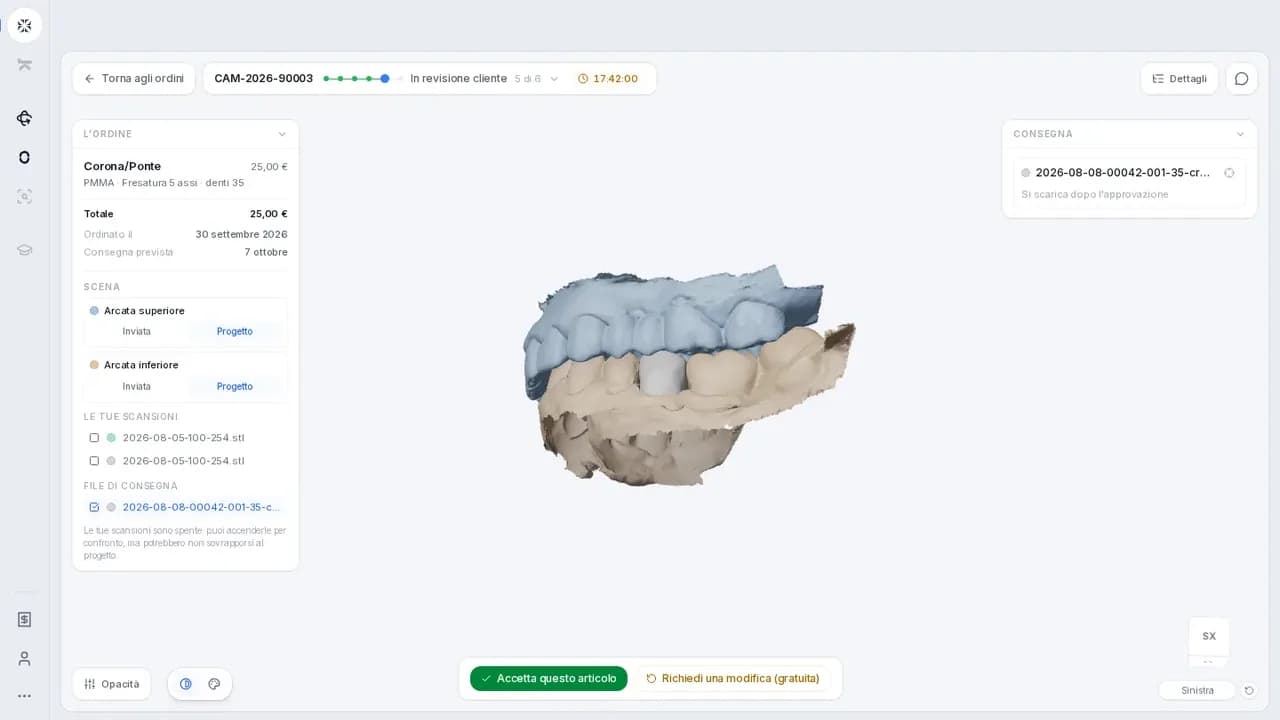
With Dentra Core, the design does not float around in emails or text messages: it lives inside the platform, in a shared workspace between the person ordering and the person designing. Revisions are requested there, received there, and approved there.
The practical workflow is simple: you upload the scan, the order starts. Within 24 working hours of confirmation, the design is ready. At that point, you can view it in 3D, directly on the platform, without downloading anything. If something is not right, you request a revision in the exact same place. Not on WhatsApp, not via email: inside the order, which keeps an accurate history of every single step.
When you approve, you approve that specific version. Not one that "should" be the right one: that exact one. And the technician working on the design has the same certainty on the other side: they know precisely what got the green light.
This changes something concrete: the approval cycle stops being a scattered trail of messages and becomes a documented step. Who approved it, when, and which version. If any doubt arises later on, you check the history and settle the matter in thirty seconds.
The Point That Always Gets Overlooked
There is one thing people often fail to consider: the issue of lost modifications almost never surfaces as such. It surfaces as a "lab error," a "miscommunication with the dentist," or "the patient wasn't satisfied." The real cause—that a correction left the design and ended up in a chat—remains invisible.
This means you can work for years with this problem without ever identifying it. You think it is a matter of paying closer attention, communicating better, or finding the right people. Instead, it is a matter of tools: if the process lacks a single place where changes are recorded and confirmed, modifications will get lost. Always, sooner or later.
You do not need a complicated system. You just need everything related to an order, from the scan to the final approval, to stay in one place, leaving a clear track at every step.
Dentra Core is built for this. You can see how it works at dentra.it/it/dentra-core.
Founder and CEO — Dentra
Second-generation dental technician, specialised in dental CAD/CAM, 5-axis milling and Toronto Bridge design. Founder and CEO of Dentra.